
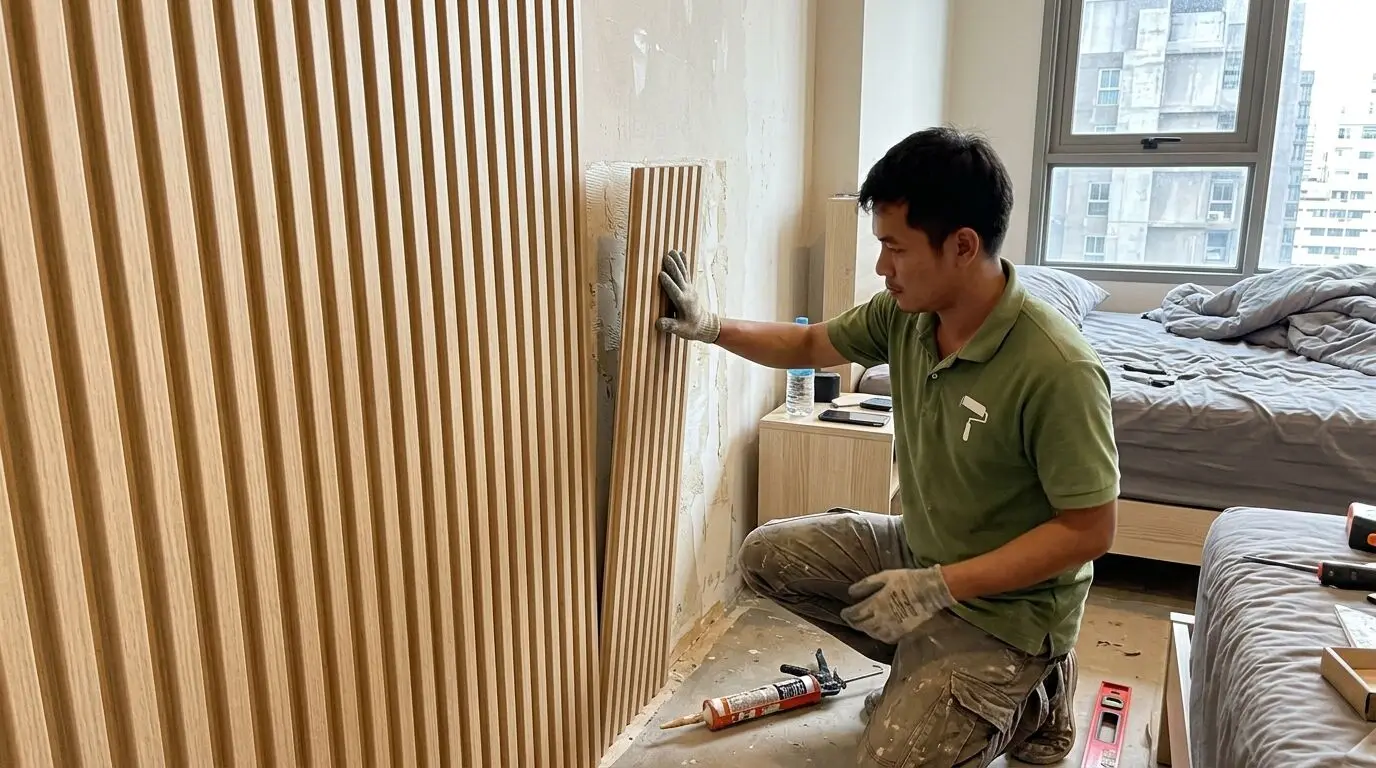
Mounting a TV looks like a ten-minute job: four holes, four plugs, a bracket. In a Bangkok condo it is the job most likely to go wrong, because the wall behind the paint is not always what it looks like.
Many condo towers have a concrete structure, internal walls built from lightweight AAC block, and a few partitions in gypsum board. They look identical once plastered and painted. They need completely different fixings.
The three wall types in Bangkok condos
Reinforced concrete
Columns, structural walls and many walls around the building core are concrete. Concrete holds almost anything with ordinary wall plugs or sleeve anchors, which makes it the best wall for a TV, including full-motion arms. It is also the hardest to drill, and it contains steel reinforcement and cable conduits. A drill that suddenly stops dead has probably hit rebar: move the hole rather than forcing it.
AAC lightweight block (อิฐมวลเบา)
Autoclaved aerated concrete block — often called by brand names such as Q-Con — is the most common material for internal partition walls in Bangkok condos. It is light, quick to build with and a good insulator. It is also soft and full of tiny air pockets.
A standard short plastic plug spins in AAC instead of expanding against it, and pulls out under load. AAC needs:
- long nylon anchors or helical (spiral) anchors designed for aerated concrete, for light to medium loads
- chemical (resin) anchors for heavy TVs or full-motion arms
- drilling without hammer action, so the hole stays the right size instead of crumbling wider
Gypsum board on metal studs (ผนังเบา / ยิปซั่ม)
Gypsum partitions are thin boards screwed onto vertical metal studs, usually about 60 cm apart, with a hollow space behind. A plug in gypsum alone has almost nothing to grip.
On gypsum, a TV bracket must go into one of:
- the metal studs, with screws designed for steel studs
- plywood backing fitted behind the board when the wall was built, or added by opening the wall
- heavy-duty toggle anchors, the kind that open behind the board and spread the load, rated for more than the TV and bracket weigh
Full-motion arms multiply the pull on the top fixings when the TV is extended. On gypsum without backing, choose a fixed or tilting bracket instead.
Clay brick, in older buildings
Older townhouses and low-rise condos often have plastered red clay brick (อิฐมอญ). Brick holds plugs well. Drill into the brick itself rather than the mortar joints, which are weaker.
How to tell which wall you have
- Knock. A hollow, drum-like sound means gypsum board. A dull, solid sound means masonry or concrete.
- Check the building. The juristic office or the developer's handover documents may show which walls are which.
- Drill a small test hole where the bracket will cover it, and look at the dust:
- grey, hard going: concrete
- red or orange: clay brick
- white and very soft, drills like butter: AAC block
- white powder, then a sudden void: gypsum board
Before drilling anything, check for pipes and cables. Cables usually run vertically above and below sockets and switches, so avoid those lines. A detector helps, but caution is the main tool. In a bathroom-adjacent wall, think about where the water pipes run.
The right height
The most common mistake after the wrong anchor is mounting the TV too high, usually because there is a convenient space above a cabinet.
As a rule of thumb, the centre of the screen should be near your eye level when seated. On a typical sofa that is about 100–120 cm from the floor.
For a 55-inch TV, the screen is roughly 68 cm tall, so with the centre at 110 cm:
- the bottom edge sits at about 76 cm
- the top edge at about 144 cm
In a bedroom where you watch lying down, the screen can go higher with a slight downward tilt. Over a sideboard, leave enough space that the TV does not look perched, and make sure the sideboard does not block an infrared remote sensor.
Choosing the bracket
- Check the VESA pattern. The hole spacing on the back of the TV must match the bracket.
- Check the weight. Use the TV's weight without its stand from the specification sheet, and choose a bracket rated comfortably above it.
- Fixed brackets sit flattest and put the least load on the wall.
- Tilting brackets help when the TV is slightly high or there is glare from a window.
- Full-motion arms let you angle the TV across the room but put the most leverage on the fixings. Use them on concrete, brick or properly backed walls.
Hiding the cables
Nothing undoes a neat TV wall like a tangle of cables hanging under it.
- Surface trunking painted to match the wall is the simplest, cheapest and condo-friendly option.
- In-wall conduit is cleaner. In gypsum it is straightforward. In concrete or AAC it means cutting a channel, which is noisy, falls under the building's drilling hours and needs replastering.
- Panel walls can hide cables completely. If you are adding a fluted feature wall behind the TV, plan the cables first. See fluted WPC wall panels.
Power should come from a socket installed behind the TV by an electrician. Do not push an extension lead or a plug-in power cord inside the wall.
Tiled walls and bathroom mirrors
Drilling tile is where DIY jobs most often crack something. Use a tile or diamond bit, start slowly without hammer action, keep the bit cool, and only switch to the masonry bit once you are through the glaze. Masking tape over the spot stops the bit wandering.
Condo rules
Drilling into concrete is noisy, and most buildings restrict it to set hours on weekdays and Saturdays. Check before booking. Never drill into the floor slab: many towers use post-tensioned slabs where a deep hole can damage a steel tendon. Our guide to juristic office renovation rules covers what buildings usually allow.
What a professional visit costs
RenoRova's handyman and mounting service costs from ฿1,490 per visit, which covers up to two hours with a two-person crew. Extra hours are ฿590. A typical visit handles a TV mount plus two curtain rails, or four shelves and a mirror.
Every visit includes checking the wall type, scanning for pipes and cables before drilling, the correct anchor for concrete, AAC, gypsum or tile, laser levelling and load-testing each fixing before letting go. Standard TV brackets, rails and anchors can be supplied at cost, and the dust is vacuumed before the crew leaves.
Send a photo of the wall, the TV model and the bracket on LINE, and we will confirm what fits in one visit before you book. Landlords get the same small-fix list inside the HostReady between-tenant reset.
Frequently asked questions
Can you mount a TV on a gypsum wall?
Yes, if the bracket is fixed into the metal studs behind the board, into plywood backing installed behind it, or with heavy-duty toggle anchors rated for the load. Plastic plugs in gypsum alone will pull out. Full-motion arms put much more leverage on the fixings and are best avoided on gypsum unless there is backing.
How do you mount a TV on an AAC lightweight block wall?
Use anchors designed for aerated concrete, such as long nylon or helical anchors, or chemical anchors for heavy loads. Drill without hammer action so the hole stays tight. Standard short plastic plugs spin in the soft block and fail.
How high should a TV be mounted on the wall?
In a living room, put the centre of the screen near seated eye level, usually about 100–120 cm from the floor. For a 55-inch TV that puts the bottom edge roughly 65–85 cm up. In a bedroom where you watch lying down, it can go higher with a slight tilt.
How much does TV wall mounting cost in Bangkok?
A RenoRova handyman visit costs from ฿1,490 for up to two hours with a two-person crew, which typically covers a TV mount plus two curtain rails. Extra hours are ฿590. Standard brackets can be supplied at cost.
How do I know what my wall is made of?
Knock first: a hollow sound means gypsum board. Then look at the dust from a small test hole: grey and hard is concrete, red or orange is clay brick, white and very soft is AAC block, and white powder followed by a sudden void is gypsum.
Need it handled professionally?
Get a guide price for your home in under 60 seconds.
Written by the RenoRova Team
We're Bangkok's documented renovation crew — everything we write comes from real painting, regrouting and flooring jobs across condos, homes and short-stay rentals.
Get our Bangkok renovation guides straight in Google — add RenoRova as a preferred source.