
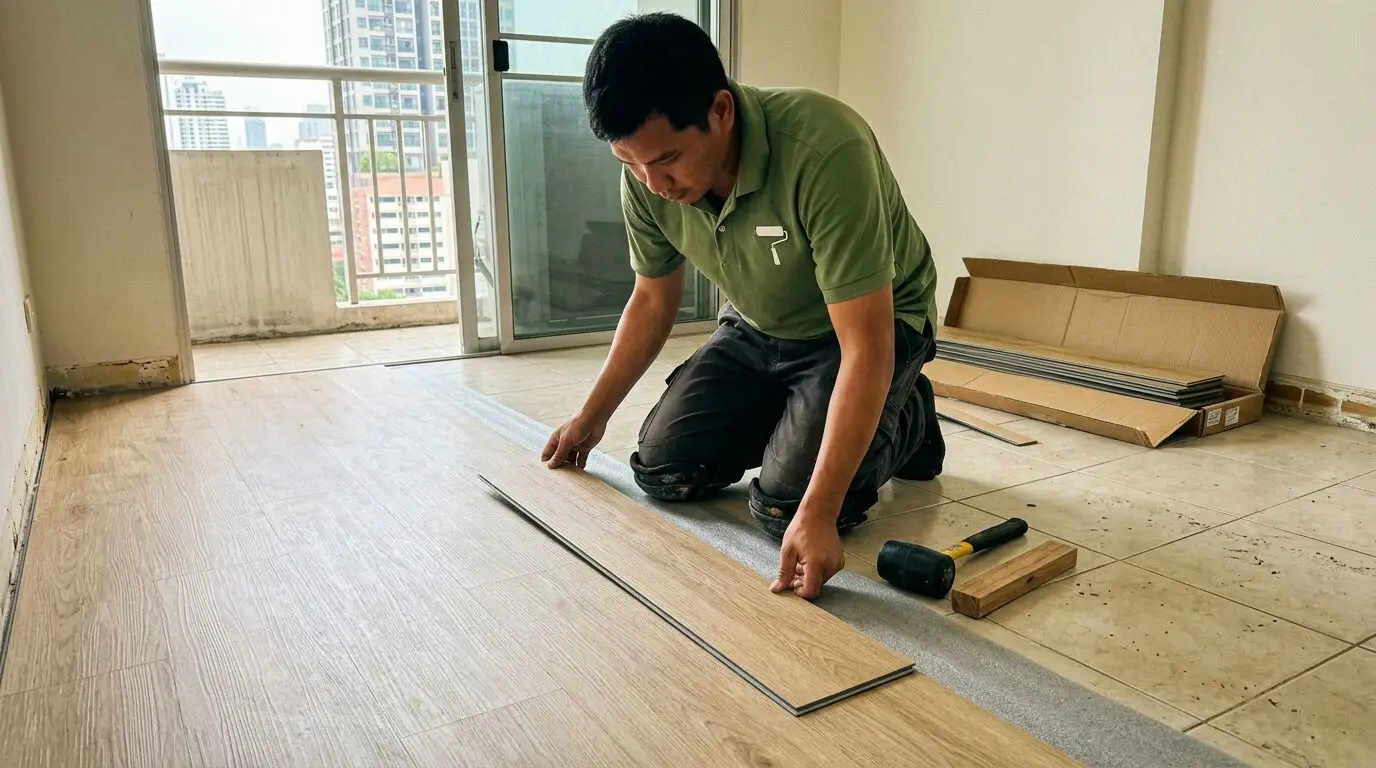
The single biggest reason SPC has taken over Bangkok condo floors is that the old tile stays where it is. No demolition, no dust, no skip in the loading bay, no juristic-office argument about jackhammer hours. The crew arrives, the floor goes down, and you are walking on it that evening.
Most tiled floors qualify. Some do not, and a crew that promises a two-day floor without checking is setting you up for planks that bounce, gap and click. This is the survey.
Check 1: flatness
SPC is rigid but it is a floating floor — it sits on the old surface rather than being stuck to it. Anywhere the base dips, the plank bridges the dip and flexes every time you step on it; over months the click joint works loose. The industry rule is the floor should be flat to about 3 mm over a 2-metre straight edge.
Bangkok condos built in the last 15 years are usually fine: developer tile is laid flat if not always well. Older townhouses with terrazzo or hand-laid ceramic vary more. A long level or straight edge across the floor in several directions shows the high spots and low spots in a minute.
- Small high spots (a proud tile edge, a lump of old adhesive) are ground down.
- Low spots and wide grout lines are filled with a levelling compound so the underlay is not bridging a groove.
- A floor that is out everywhere gets a thin self-levelling screed first — an extra day, quoted at the survey.
Check 2: is every tile bonded?
Tap the floor as you walk it. A hollow sound means the tile has come away from the adhesive. Left alone under SPC, a hollow tile eventually cracks or rocks, and the plank above it moves with it. Hollow tiles are either re-bonded by injecting adhesive or lifted and re-set before anything goes on top. Two or three hollow tiles are routine; a floor that sounds hollow everywhere is a floor that should probably come up.
Check 3: moisture
A floating floor over a damp base traps the moisture. If there are stains, efflorescence (white salt crust) or a musty smell, the cause is found first — usually a bathroom or balcony joint next door, or rising damp on a townhouse ground floor. A moisture reading goes in the report either way.
Check 4: height and doors
SPC adds 5–8 mm to the floor: a 4–6 mm plank plus a thin underlay. That sounds like nothing until a door will not close. Every interior door is measured and trimmed at the bottom before the floor goes down. Thresholds change at every doorway, especially into bathrooms where the tile stays. The bottom of built-in wardrobes, the fridge alcove and any sliding-door track are checked — a wardrobe door that clears the tile by 4 mm will not clear the SPC.
Check 5: wet areas and falls
SPC is waterproof and can go in kitchens and bathrooms, but a bathroom floor has a fall to the drain that the floating floor would flatten. In practice most people leave bathroom tile in place and overlay everything else, with a threshold at the bathroom door. Kitchens are overlaid routinely.
When you should not overlay
- Tiles loose or cracked across a large area — remove and start from the screed.
- Active damp that cannot be fixed from your side — fix the source first.
- A floor out of level by more than a screed can sensibly fix — rare, but it happens in old ground-floor townhouses.
- You want tile again — obviously.
In these cases RenoRova quotes a new floor from the screed up after the free survey.
What the day looks like
Skirting comes off (reused or replaced). Hollow tiles fixed, high spots ground, grout lines filled. Underlay rolled out. Planks click in from the longest straight wall with joints staggered and an expansion gap at every edge and doorway. Cuts around pipes and frames. Skirting, thresholds and door trims go on, doors rehung, floor cleaned, and you walk every room with the crew lead before the photo report goes to your phone. One day for a studio or one-bedroom, two for most two-bedrooms.
Guide prices by home size are on the pricing page; the plank options and what is included are on the SPC flooring page. If you are unsure whether your floor qualifies, send a short video of you tapping it on LINE — a crew lead will tell you before you book.
Frequently asked questions
Do I need to remove old tiles before laying SPC?
In most Bangkok condos, no. SPC is a floating click-lock floor designed to go over a hard, flat surface, and bonded tile is an ideal base. Removal is only needed if tiles are loose, cracked or badly uneven, or if the floor has a damp problem underneath.
How much height does SPC add to the floor?
Usually 5–8 mm: a 4–6 mm plank plus a 1–2 mm underlay. Interior doors are trimmed at the bottom to suit, thresholds are fitted at doorways, and any built-in furniture that sits on the floor is checked before the day.
What if my floor is not flat?
Small high spots are ground down and low spots or wide grout lines filled with a levelling compound before underlay. Floors out by more than about 3 mm over 2 m in many places are levelled with a self-levelling screed first, which adds a day and is quoted at the survey.
Need it handled professionally?
Get a guide price for your home in under 60 seconds.
Written by the RenoRova Team
We're Bangkok's documented renovation crew — everything we write comes from real painting, regrouting and flooring jobs across condos, homes and short-stay rentals.
Get our Bangkok renovation guides straight in Google — add RenoRova as a preferred source.